

News
Members' Zoom Lecture on the Battle of Hastings
20 October 2026
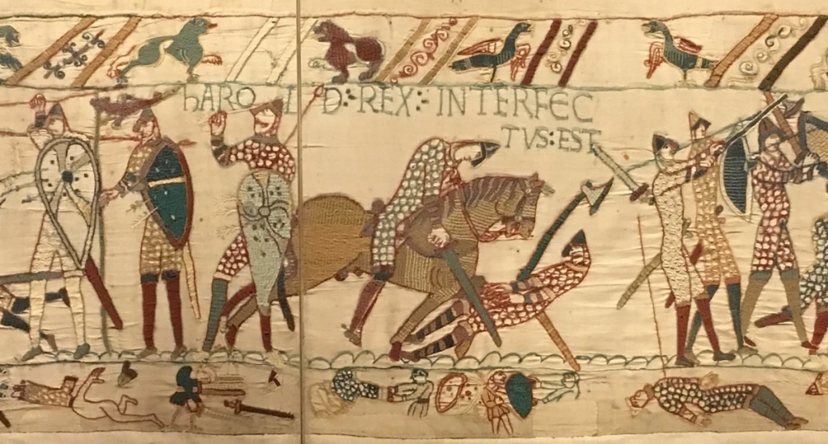
On 24 October over 180 of our members tuned in to listen to our SE Region Chair Julian Humphrys discuss aspects ot the Battle of Hastings as well as its depiction in the Bayeux Tapestry. A recording of his talk will shortly be available in the members' section of this website but his main arguments were: 1. The evidence does not support attempts to argue that the battle was not fought on its traditional site, ie where Battle Abbey now stands. 2. A study of the topography suggests that there should be a slight realignment of the the two armies, with the English army facing the Norman advance from the SE. 3. In the Bayeux Tapestry death scene, Harold is the figure being cut down, not the figure that now has an arrow in his eye.
In order that as many as possible questions could be answered, listeners were invited to submit comments and questions in writing and informed that Julian's responses would be posted here on this website. These now follow:
Q. Have you seen the piece by Roy Porter 'On this very spot' English Heritage Historical Review, 2012, vol. 7, pp. 4-17.? Also, Prof. John Gillngham recently (last year) has the main combat at 'Santlache' on the road pretty much where your map shows... (Also, I agree about the spear not arrow.)
A. Yes indeed, and thanks for pointing this out. I’ve spoken with Roy on a number of occasions over the years and I think he is also in agreement about the orientation of the forces. There’s a summary of his argument in favour of the Battle site on the Battle Abbey section of the EH website.
Q. If you swing the English line round in the new layout, will you lose protection from cavalry for their western flank from the end of the 'hammerhead' ridge?
I don’t think so. With the slight alteration to the orientation of the armies, Harold’s forces would now have a NE and a SW flank and if deployed at the narrowest part of the ridge I think both would have received protection from steep slopes above boggy ground. Interestingly I think the traditional E-W deployment facing south would have left the English left flank vulnerable to attack.
Q. Thanks for tonight's Battlefields Trust talk. An aspect I found particularly interesting was moving the focus of the battle to the east, in line with the Norman approach. Could you please explain the photo that you discussed briefly before returning to the Tapestry? I think you said it showed steep ground to the north but I wasn't sure where you meant. Having walked around the area last year, it would be useful to know where the photo was taken and in which direction
A. It's looking NE from the north side of the Senlac Ridge. St Mary's Church is up and behind you. It hasn't been landscaped like the south side and is an area of steep slopes, a stream and boggy ground and my interpretation of the English alignment has it protecting their left flank and not to their rear
Q. How would the monasteries have got news of the battle and the events that unfolded?
My understanding is that at some time, probably in the reign of Alfred the Great, the various religious establishments were given a common text which they added to and then updated with information they thought was worthy of record. How did they get this information? It is worth bearing in mind that they weren't isolated establishments, cut off from the outside world. They would have gleaned information both from visitors and as a result of their own activities outside of their religious house where senior members would have come into contact with and received information from a variety of sources - senior churchmen for example.
Q. You mentioned crossbowmen (I think at around 20:42 hrs). What evidence is there relating to crossbows around this time? There are none as far as I know depicted on the Tapestry.
A. Crossbows were certainly in use in 1066, as they had been amongst the Franks before that. Both William of Poitiers and the Carmen mention crossbowmen and crossbow bolts in their accounts of the battle. As far as I'm aware Harriet Wood's 'Battle of Hastings' is the only publication to doubt the presence of crossbowmen at the battle but it gives no supporting evidence for this. However noted experts like Christopher Gravett and Jim Bradbury entertain no such doubts. Why do they not feature in the Tapestry? Perhaps because the English artists were unfamiliar with them.
Q. The inscriptions often appear to be added after images and flow around them - the text is also quite basic compared to the complexity of the story. I think it also lacks the more partisan and poetical descriptions of other sources. Would you agree and if so, why do you think this is?
A. I think the Tapestry's message is essentially a visual one.
Q. Harold had his fleet at sea to counter an invasion - but was there any method of ships physically engaging and attacking enemy vessels - or was the purpose linked to observation?
A. Yes there was. In fact Harold Hardrada had wone a naval battle over the Swedes in 1062. Perhaps the best-known naval battle of the wider period was Svolder in 1000. It seems likely that the ships were brought up alongside those of their opponents and used as fighting platforms.
Do you have any recommendations for reading about the images in the borders (of the Tapestry)
Musgrove and Lweis's 'Bayeux Tapestry' looks at them in the context of the Tapestry of a whole and is probably a good starting point.
 Members' Zoom Lecture on the Battle of Hastings
20 October 2026
Read More
 Battlefields Trust Heritage Open Day Events Help Promote Battlefield Heritage
23 September 2026
Read More
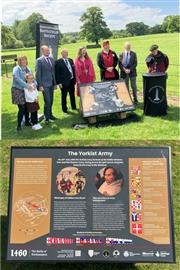
 New First Battle of Newbury Information Board Unveiled
21 September 2026
Read More
 Battle of Winwick - New Information Board Installed in St Oswald's Church
15 September 2026
Read More
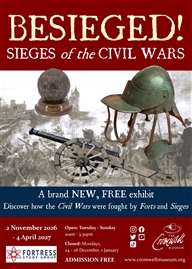
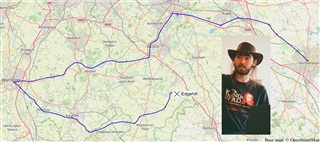 A Civil War hike - following the footsteps of the Earl of Essex's parliamentarian army
13 July 2026
Read More
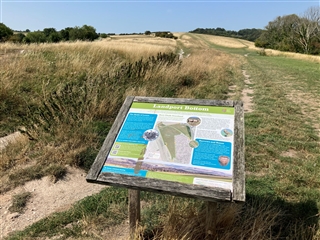 Natural England publishes new environmental guidance for the management of historic battlefields
23 June 2026
Read More
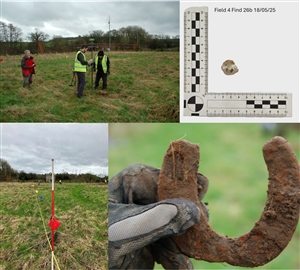
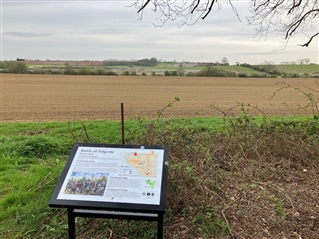
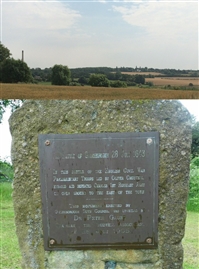 Historic Environment Records and Battlefields
23 March 2026
Read More
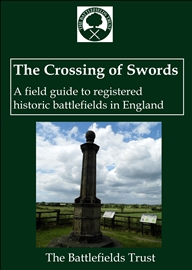 Now available! A field guide to registered historic battlefields in England
18 November 2025
Read More
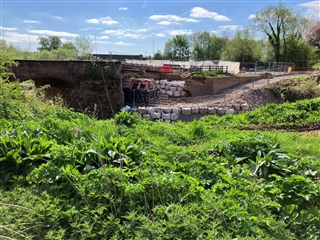
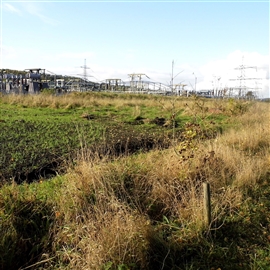 Battlefields at risk - Historic England publishes its revised Heritage at Risk register
6 November 2025
Read More
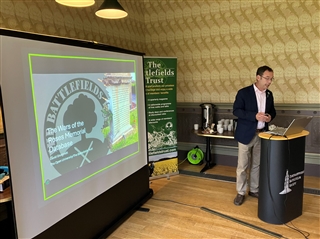 Formal Launch of the Wars of the Roses Memorial Database
15 October 2025
Read More
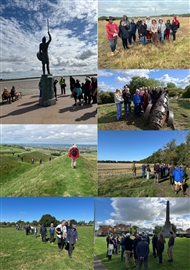 Big Battlefield Walks Weekends prove successful despite the weather
23 September 2025
Read More
 HS2 damages nationally important battlefield
18 September 2025
Read More
 Bosworth battlefield sculpture trail opened
18 September 2025
Read More
 New Civil War battlefield memorial and information board unveiled at Middleton Cheney
6 June 2023
Read More
 Battlefields Trust Journal - Call for submissions
20 October 2022
Read More
