

Battle of Assandun
18th October 1016
NAME: Battle of Assandun
DATE: 18th October 1016
WAR PERIOD: Britons, Saxons & Vikings
START TIME AND DURATION: ??
OUTCOME: Danish victory
ARMIES AND LOSSES: An Anglo-Saxon army under King Edmund Ironside and Danish [Viking] army under King Cnut. The size of both forces and their losses are unknown
LOCATION: unlocated
MAP DETAILS: Not applicable
The decisive but locationally elusive battle that ultimately resulted in Cnut becoming undisputed King of England
The Battle of Assandun took place on 18 October 1016* in Essex. The Danish army under Cnut defeated an English army under Edmund Ironside, ultimately resulting in Cnut being accepted as King of England.
Details of the actual battle are very limited. The numbers involved are not known, but unlikely to be more than a couple of thousand on either side, possibly many fewer. The Encomium Emmae Reginae, although written in the 1040s had as its source Queen Emma, King Ethelred's widow and King Cnut’s wife, and it says that the battle started in the ninth hour of the day (which is 2-3pm) and went on all day until dusk.
Some of the primary sources (the Anglo-Saxon Chronicles, the Encomium Emmae Reginae) describe how, as the Danes and the Saxons came together at Assandun, one of the Saxon leaders, Edric Streona, the Ealdorman of Mercia, either held his men back, or led them off the field completely. The Danes were victorious, and many of the English nobility were slain. Edmund escaped with a significant force, and retreated towards Wessex.
Cnut pursued Edmund, and a meeting was arranged between them, on the Island of Alney in the River Severn, near Deerhurst. They agreed to share the kingdom between them – Edmund taking Wessex, and Cnut taking Mercia – and become each other’s heir, so when one of them died, the other would become king of all England.
Edmund died a few weeks later, on 30 November 1016. Consequently, Cnut became the undisputed king of England. In 1020, Cnut had a minster church built at Assandun to commemorate those killed in the battle.
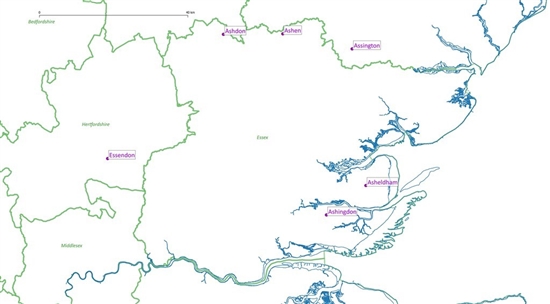
Based on the linguistic analysis of the name of the battle – it is recorded variously as Assandun, Assatun, and Aescenedune – the two localities favoured by most historians are Ashingdon- Canewdon in South East Essex, and Ashdon-Hadstock in North West Essex. But other sites – Assington in Suffolk (only a few miles from the Essex border), and Essendon in Hertfordshire (further from the Essex border) – have separately been suggested. Essex also has Asheldham and Ashen that may be worth investigation. Ashingdon/Canewdon and Ashdon/Hadstock both have good candidates for the minster church founded in 1020 by Cnut in memory of the victory.
The battle of Assandun was the decisive battle that led to the conclusion of the Danish conquest of England; but its impact was much more significant than just a change in ruling house. The battle, the events leading up to it, and its aftermath, set the scene for what would happen 50 years later at Hastings with the Norman conquest of England. The battle, and Cnut’s resulting triumphant North Sea Empire, had entwined the throne of England with Normandy and Norway for future generations.
(*) It is recorded in the Anglo-Saxon Chronicles that Eadnoth, the Bishop of Dorchester, was killed at the Battle of Assandun. His obituary appears in a late 12th century Ely calendar (Trinity College Cambridge MS O.2.1), giving the date of his death as 18 October.