click here to print

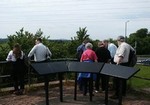 The viewpoint beside the bypass has been vandalised.
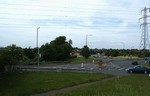 On the east side of the Severn much of the battlefield has been built over, as here looking north from the viewpoint towards the city.
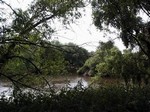 The confluence of Teme and Severn close to where the bridge fo boats was built.
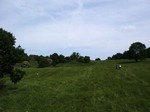 Perry Wood Hill where part of the parliament army was deployed, overlooking the city.
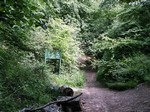 The line of the old road running north east from the city can still be traced where there is a deep hollow running up the hill through Perry Wood.
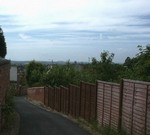 The city viewed from Red Hill, where other parliamentarian divisions encircled the Worcester.
 Shot impacts on Powick church probably relate to the initial skirmish as parliamentarian forces secured the south bank of the Teme the night before the battle.
 The westernmost of the parliamentarian attacks went in over Powick bridge.
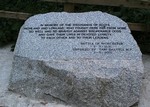 Memorial to the Scots at Powick Bridge.
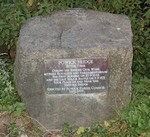 A tiny memorial marks the action at Powick Bridge.
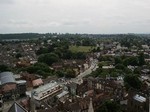 The view from the cathedral tower to the site of Fort Royal in the small park, with Red Hill and Perry Hill in the distance.
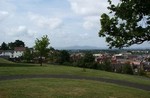 Earthworks of Fort Royal still survive in the park.
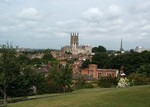 Fort Royal had to be protected by a royalist artillery fort, because it dominated the city.
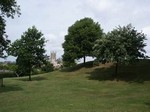 The earthworks of Fort Royal.
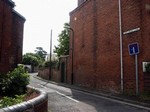 Fort Royal is now encompassed on all sides by 19th century development.
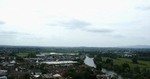 The royalists viewed the battlefield from the cathedral town, which gives excellent views on all sides of the city, as here looking south towards Powick.
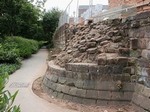 A few tiny remnants of the town wall still survive.
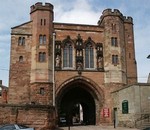 The cathedral gate survives, but none of those on the city defences.
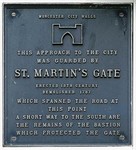 The site of the gates are maked by modern plaques.
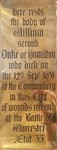 The Duke of Hamilton was killed inthe royalist counter attack on the east of the city.
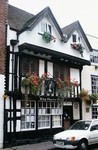 The house from which Charles II began his escape from Worcester, as parliamentarian forces were fighting their way into the city.
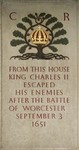 Plaque on the house from which Charles began his escape.
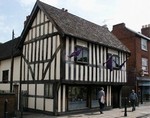 The Commandery houses England's only substantial Civil War interpretive facility.
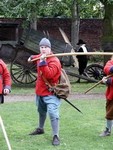 Civil War events are regularly staged in the Commandery.
 Living history events at the Commandery are not restricted purely to the military aspects of life during the Civil Wars.
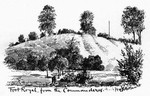 Fort Royal as it was in 1896.
Battle of Worcester
3rd September 1651
The Battle of Worcester, the last battle of the Civil Wars, was fought on 3rd September 1651; nine years earlier the first substantial action of the war had taken place barely two miles to the south of the city, at Powick Bridge. Whereas that first skirmish had been a dramatic success for Prince Rupert's Royalist cavalry, by 1651 it was Parliament's New Model Army that was the dominant military force. The battle of Worcester destroyed the final hopes of the Royalists regaining power by military force. Charles II was forced into exile and the long and bitter Civil War was over, appropriately ending where it had begun. This was Cromwell's last great victory in battle and it secured his dominant position, political as well as military, contributing to his appointment in 1653 as Lord Protector.
The area to the south of Worcester between Powick Bridge and the confluence of the Severn and Teme is the best preserved part of the battlefield. Here the ground is still open agricultural land, where the manoeuvres of the armies between the bridge and the position of the pontoons can be best appreciated. Further north and to the east of the city late 19th and particularly 20th century development has destroyed large parts of the battlefield and most traces of the landscape within which the action was fought here. However there are some surviving undeveloped areas in key locations, most notably Perry Wood.
A visit to the battlefield is well worthwhile. Within the city there are several buildings and monuments associated with the battle, and the top of the cathedral tower still gives the best view of the battlefield, as it did for Charles II in the hours leading up to the main action. At Powick church shot impact scars can be seen on the tower, probably resulting from the initial skirmish as Fleetwood's troops secured the south bank of the Teme. There is a Civil War visitor centre in the Commandery, on the south side of the historic core of city. Nearby in a small hilltop park are the slight earthwork remains of Fort Royal, a Royalist artillery fort that was being constructed to protect the south east side of the city, where some of the action was played out in the later stages of the battle. Iinformation panels have been erected here by the Battle of Worcester Society. There is good access to Powick Bridge, now by-passed by the modern road, and there are a number of footpaths leading across the battlefield, including paths on the north side of the Teme and on both sides of the Severn.
- Historic England Battlefields Register CLICK HERE
- Historic England battlefield report for Battle of Worcester 1651 with Powick Bridge 1642
Worcester pages compiled by G Foard and T Partida, May 2005. Edits by S Marsh 2016.
© 2004 The Battlefields Trust.
This website was created with the support of the Heritage Lottery Fund and the Hartnett Trust